Tags
apple, iOS 5, iPhone, iPhone 4S, Siri, smartphone, technology
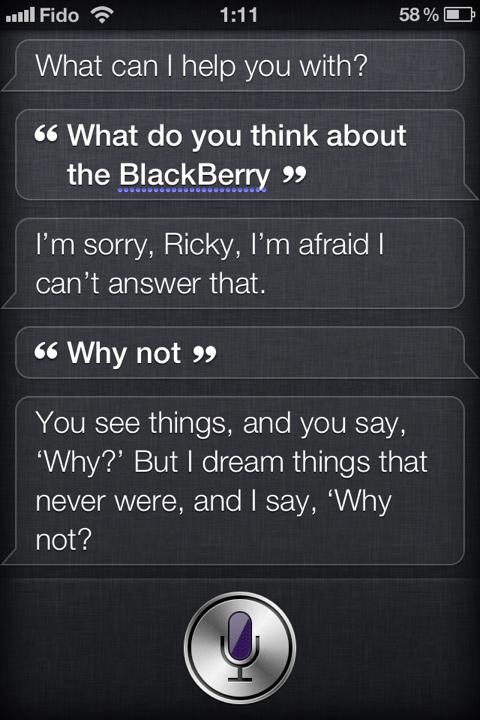
Because everyone else is doing, so I might as well pile in …

19 Wednesday Oct 2011
Posted in Apple, iPhone, technology
Tags
apple, iOS 5, iPhone, iPhone 4S, Siri, smartphone, technology
Because everyone else is doing, so I might as well pile in …
17 Monday Oct 2011
Posted in Apple, iPhone, technology
Tags
apple, iOS 5, iPhone, iPhone 4S, Siri, smartphone, technology
You’ve seen all those news stories about how Siri on iPhone 5 4S doesn’t give directions in Canada.
But it seems mapping technology will work if you tell your iPhone that you’re going to the United States.
I asked Siri to show me directions to get to Anchorage, Alaska, and she happily showed me how to get there, even offering an alternative route within Canada.
It will be awesome once Siri is able to show driving, transit and walking directions for destinations within our own country.

17 Monday Oct 2011
Posted in Apple, iPhone, technology
Tags
apple, battery, battery life, iOS, iPhone, iPhone 4S, smartphone, standby, standby time
Tech/Apple geeks everywhere have been curious as to why the Apple 4S has 100 fewer hours of standby time than its predecessors.
Indeed, It claims only a maximum of 200 hours of standby time now, versus 300 hours with older iPhones.
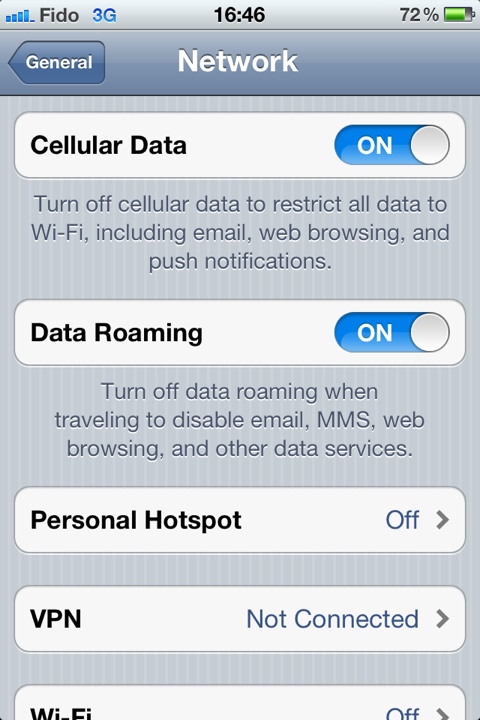
I’ve got another guess as to why this is so: You can no longer force your iPhone to operate only on 2G (EDGE).
I might have been the only iPhone user to deliberately use a slower cellular network most of the time, but I’d done so to reduce battery consumption while the phone was idle.
With light usage and limiting the phone to 2G (turning 3G on only when I needed it) I could go three, four or sometimes even five days between recharges.
As I giddily unwrapped and set up the iPhone 4S that arrived this morning, I flicked through the menus only to find the “enable 3G” option is gone.
Too bad. It was a neat little trick to help reduce energy consumption.
Perhaps, if I beg hard enough, Apple will bring it back?
13 Thursday Oct 2011
Posted in Apple, iPhone, technology
Tags
apple, cellular, iOS 5, iPhone, mobile, operating system, smartphone
I’ve had iOS 5 installed on my iPhone 4 since it became available shortly before lunch on Oct. 12. Here are some quick and dirty impressions after about a day of use.
Installation: Pretty painless. The download took only a few minutes over broadband Internet. The process of backing up and restoring my iPhone took a fair amount of time — more than 30 minutes.
iCloud: Upon turning on for the first time after the OS update, the phone asked me if I wanted to sign up for iCloud. I accepted. The process took only a few minutes, no doubt shortened because I already had an iTunes/Apple ID account.
I was able to use the set which parts of my iPhone’s content I wanted to back up in the cloud. It doesn’t take much to start gobbling up the seemingly massive 5 GB of backup space. It makes sense, though: My camera roll items are almost 2 GB to just to themselves.
I still haven’t fully explored the capabilities of iCloud. Once I’ve done so, I’ll report back to you.
Notifications in general: I love the new notifications screen. With a swipe of the finger from the top of the screen, I can call up the weather and stocks info without switching apps.
If I’ve skipped calls, text messages, reminders and other such messages, they all queue up there for viewing.
You can set which programs get to live in the notifications screen and how they alert you.
The notifications screen is also available in your lock screen but only if there are new messages/alerts to show you. You’ll see a ridged tab-like icon near the clock, which you can drag down to reveal the notifications.
Messaging/phone call notifications: When I got a text message whilst setting up my phone, the message innocuously dropped down from the top of the screen in a small banner and discretely retreated a few seconds later. Clicking on the message as it appears or selecting it later from the notifications screen will invoke the messaging app for me to respond.
If you prefer the old-school, intrusive text message notification, you can choose “Alert” under Settings > Notifications > Messages > Alert Style.
Phone calls, calendar items and timed reminders have the intrusive “Alert” notifications as a default.
The app formerly known as iPod: Apple has split the music and video portions of the former iPod app and called them — you guessed it — Music and Video respectively.
Newsstand: As the name of this app suggests, this is a Books-style app for newspapers and periodicals. Currently, the Canadian app store has a very limited number of titles for sale. The only icon my Newsstand contains is one for The New York Times, a virtual copy of the standalone NYT app I already own.
Camera from the lock screen: It took me a few hours to figure out that you have to double-click the home button to access the native Camera app from the lock screen. (It’s the same process you’d use to access Music controls when your phone is locked.)
You won’t have access to the full contents of your camera roll until you unlock the phone.
Auto-lock while using AirPlay: Some video-streaming apps (including Livestation and the National Film Board, for example) used to prevent the phone from locking itself while playing. However, this isn’t happening anymore when streaming to Apple TV using AirPlay. If you have auto-lock selected, the app stops and your phone locks after the set time interval elapses. Seems like a bug.
In contrast, the phone does not lock if the video is streaming through iPhone itself.
Other considerations: To allow for iCloud, some iOS 5 features and some feature exclusive to the upcoming iPhone 4S, the following may require a software update.
• The OS on your Mac
• iTunes
• iPhoto, Aperture, iMovie
So those are my initial observations and impressions of iOS 5. Check back in a few days to give me a chance to put the operating system to the test under extended, everyday use.
22 Wednesday Dec 2010
Posted in Uncategorized

 Ricky Leong