Recently built a little lightbox for shooting random, small objects. This is the result of one such shoot.

Dicey situation
02 Saturday May 2009
Posted in photography, random, studio

02 Saturday May 2009
Posted in photography, random, studio
Recently built a little lightbox for shooting random, small objects. This is the result of one such shoot.
02 Saturday May 2009
Posted in architecture, art, fun, history, photowalking, Quebec City
Tags
art, canada, mural, Quebec City, random, Travel, urban photowalk
An oldie but a goody, from way back in August 2003.

27 Monday Apr 2009
Posted in broadcasting, journalism, media, newspapers, radio
Tags
blog, blogs, broadcasting, hyperlocal, local, local news, media, news, newspaper, newspapers, television, TV
I recently read an article from the New York Times about a trend toward hyperlocal blogging.
The people who run these outfits purport to provide timely, accurate local information mostly through volunteer bloggers and contributors. A handful of sites actually employ journalists.
It is said that with the imminent death of mainstream TV and newspaper media, these hyperlocal blogging sites will be a key source of information for communities.
That said, many of these hyperlocal sites buy their content from newspapers and TV stations. How are these sites to survive without the mainstream media outlets that feed them?
I can’t imagine a volunteer blogger spending his entire day hanging out at city hall, five days a week, to keep an eye on what our elected officials are up to. Or perhaps dragging kilos of camera and sound equipment around to cover a story, then spending hours cutting an awesome multimedia presentation.
Even journalism students are encouraged to find paying jobs — at least that’s how it was when I went to school.
I hope not too many more media outlets bite the dust before people realize how important professional local news outfits are to their communities.
27 Monday Apr 2009
17 Tuesday Mar 2009
Posted in Uncategorized
Not more than a couple of days since my last post and another newspaper bites the dust … sort of.
The Seattle Post-Intelligencer print edition for March 17 will be its last, with the news outlet moving to an online-only format.
The New York Times reports much of the editorial staff is gone, save for a few columnists who will be blogging the local news.
Does this mark the beginning of the end of non-commentary news reporting?
I will touch upon this in a future post.
14 Saturday Mar 2009
Posted in Internet, journalism, media, newspapers
Tags
blog, blogging, journalism, media, newspaper, newspapers, online, reporters, reporting
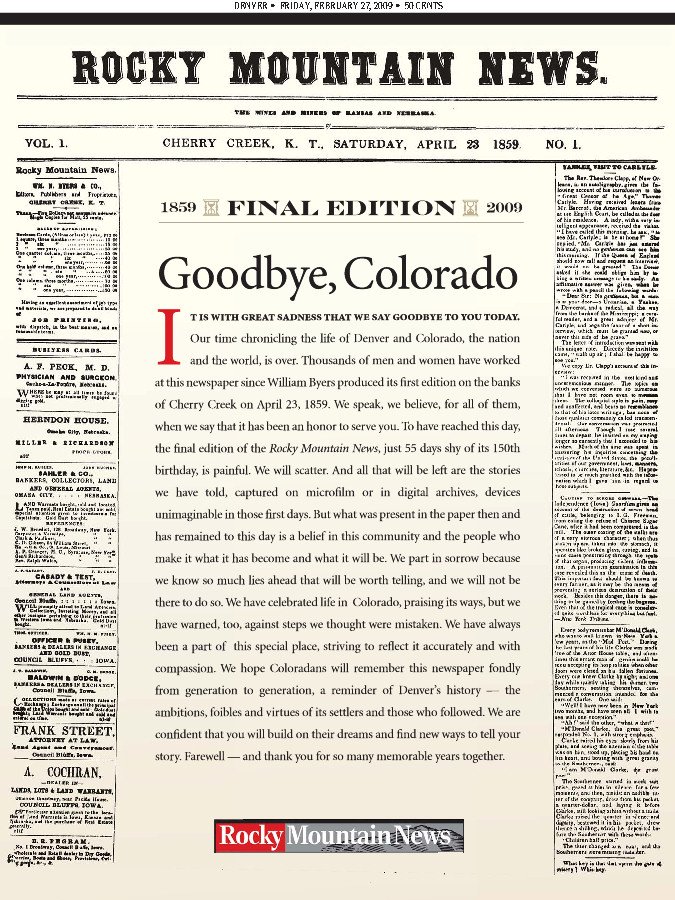
Final front page of the Rocky Mountain News (via Newseum.org)
It is with sadness that I note the passing of the Rocky Mountain News, which ceased publications a few weeks ago.
It, like many other publications, was feeling the pressure of the economic crisis currently gripping businesses around the world. The paper was bleeding millions in red ink before it was shut down, throwing hundreds of staff out of work.
Sadly, with many newspaper owners reporting distressing financial results lately, I fear more papers around the world will succumb to the recession.
Some would have you believe newspapers are irrelevant anyways, economic slowdown or not, that the industry is so behind the times it couldn’t possibly keep up with the digital age. Just type in “newspapers” and “dead” in Google and you’ll see what I mean.
But not all newspapers are in dire straits. Not all newspapers are slow to adapt to the new online media environment. (The word “newspaper” might be a bit of a misnomer anyways, seeing how so many publications have good websites including multimedia, updated through the day and night with breaking news.)
I’m not just saying all this because I work for a newspaper.
What will the talking heads and political pundits talks about if there are no traditional-media reporters digging up stories? What will the bloggers blog about if there is no source material to which posts can be linked back to? (Ironically, the posting you’re reading now falls into this category, as I have done very little original reporting in writing this.)
One of the reporters I work with had one of his feature stories on wrestler Owen Hart re-written and posted online by a specialty site devoted to WWE. Sure, the text credited our newspaper and the article linked back to our website (thank you, by the way) but the person who put up the posting — and whose name appears at the top of the article — did no original research, made no phone calls, took no photos and shot no video. Our reporter and photographer/videographer did all the work. Worse yet, Google News rates the copycat article as more relevant than the original.
Another reporter noted one of his friends claimed she was trying to “confirm” the release of a Canadian aid worker for Doctors Without Borders who was held in Darfur this week. I write “confirm” in quote marks because this person was writing an article using news stories on the Internet as her source. This person did not call the Canadian embassy nearest to Darfur to check on the status of the aid worker, nor did she call the worker’s family or Doctors Without Borders to see how she was doing.
Without the work of traditional-media journalists, the news aggregators of the Internet would have a lot of down time on their hands.
That, and Google News would be mostly blank.
Sure, there are news bloggers and aggregators out there who do original work. Many of them blog as a side task to a paid journalism job. But I bet the vast majority of bloggers do little or no original research or interviews, simply using the Internet as a spark to share their ideas on the back of someone else’s work.
It’s an important function of the web — but you can’t call it reporting. You can’t call it news.
Let’s hope the bloggers and aggregators out there recognize all the help they get from those of us in traditional media — newspapers, radio and TV — who spend our lives doing the legwork that makes active and constructive Internet discussion possible.
28 Wednesday Jan 2009
For whatever reason, my Calgary Sun column didn’t make it onto our website, so here it is for your reading pleasure.
Ricky Leong
Sun Media
It’s budget day in Canada and it’s expected to be one of the gloomiest budget speeches we’ve heard in a little while.
Its contents have been leaked to the public over the last few days. It was revealed yesterday some $7 billion would be poured into infrastructure projects, much of which is slated for already-approved provincial and municipal projects and so-called green infrastructure.
As we wait for the specifics of this massive — perhaps reckless? — spending to be sorted out, perhaps it’s time to re-examine that holy grail of Alberta infrastructure projects: The Calgary-Edmonton high-speed train.
For the last few decades, studies have been commissioned to evaluate the viability of linking Calgary, Red Deer and Edmonton by train.
They all tout the benefits of a high-speed train — downtown-to-downtown service, lots of room for passengers, productive use of time and fast and frequent service.
They note this corridor is populous and densely populated. They state the service would be profitable, given a properly priced, convenient product.
As attractive as such an ambitious project might be, and as much as I love the concept, this is perhaps too much, too soon.
The train used to stop here. Via Rail service from Calgary to Edmonton was discontinued in the mid-1980s and service to Vancouver, Winnipeg and Toronto ended in 1990.
For some 20 years, our medium- and long-distance ground transportation options have been limited to standard or luxury bus services, or just simply driving our own vehicle.
I never rode those Calgary-Edmonton trains. From reading passenger accounts from that time, the service was doomed by equipment prone to breakdowns, relatively slow running (at best, it was no faster than driving) and endless level-crossing accidents.
Therein lies the problem. A whole generation of Calgarians has grown up without having seen a regularly scheduled intercity passenger train pass through here.
Those who do remember the train probably have a poor opinion of it. The customer base must be rebuilt from scratch.
Building a new high-speed rail service would require a lot of funding. As much as governments appear to want to spend these days, some measure of private financing would be required for a project of this nature — just the kind of financing that’s so difficult to obtain as a result of the credit crunch.
More useful, to start, would be basic train service, using common conventional equipment capable of rolling at 160 km/h. (Most high-speed proposals call for 300 km/h service, with electrified equipment.)
The popularity of moderately fast trains can’t be underestimated.
Via’s Quebec-Windsor corridor trains are well used, even though they go no faster than 160 km/h.
In the U.S., Amtrak’s Northeast Corridor trains have enjoyed ridership gains since the introduction of
200-km/h service between Boston and Washington, D.C., at the beginning of this decade.
Turning our focus back to Alberta, we could build along existing rail rights-of-way while eliminating all railway crossings and re-aligning curves where necessary. This would keep train speeds high and costs low. It would also allow for smaller towns along the route to have train service, forming a backbone upon which we can graft true high-speed rail later.
Economic stimulus or not, Calgary and Edmonton need to be linked by rail again.
But just as a child is taught to walk before he’s taught to run, we should consider modest steps to rebuild intercity passenger rail service in southern Alberta before we take the plunge for true high-speed rail.
ricky.leong@sunmedia.ca
24 Wednesday Dec 2008
Tags
Check this out, from one of my contacts on Zooomr:

Why so happy, Santa? by vondervotteimittiss on Zooomr
It seems whoever designed this thing wasn’t thinking things through. Oh well, at least we get a laugh out of it. Merry Christmas to all!
02 Tuesday Dec 2008
Posted in Uncategorized
Excerpts from my Sun column today:
As we watch the political machinations in Ottawa with a mix of interest and horror, perhaps there is a lesson to learn from south of the border.
U.S. federal politicians (are) willing to work across party lines to take action needed to give a boost to their economy.
It remains to be seen what the effect of all the goodwill and co-operation will be in the U.S.
All the same, Canada’s parliamentarians would do well to heed those sorts of messages as they snipe across the floor of the Commons, creating a political crisis that threatens to derail Canadians’ confidence in the political system — or worse, the economy.
Every minute our politicians spend on their partisan politics is a minute wasted that could have been used to shore up our economy and help those most affected by the market meltdown.
The only coalition that should exist in Parliament is one where members of all four parties — even the separatists — put their heads together and get to work putting Canada’s fiscal house in order and helping Canadians get through expected bad times.
Read more here
http://calsun.canoe.ca/News/Columnists/Leong_Ricky/2008/12/02/7604171-sun.php
27 Thursday Nov 2008
Took a few minutes just west of Creston, B.C., to snap a few shots with my cheap-o Canon portable digicam. This is one of my favourites from the set.

See the rest of them here:
http://www.zooomr.com/photos/rleong101/
http://www.flickr.com/photos/rleong101/

 Ricky Leong