
Just because “berserk” is a cool-sounding, cool-looking word. There is no other reason for the photo or this blog posting. 🙂

04 Friday Oct 2013
15 Saturday Jun 2013
Posted in fun, journalism, random
16 Saturday May 2009
Posted in Internet, journalism, media, newspapers
Tags
calgary sun, calgarysun.com, Internet, journalism, media, news, newspaper, web
The Calgary Sun website recently got a radical makeover.
The result is a much cleaner layout for better reader navigation.
There are also new features, including RSS feeds and browsing for your mobile phone.
The change also means my columns have a new home.
Please go check it out if you have a moment.
27 Monday Apr 2009
Posted in broadcasting, journalism, media, newspapers, radio
Tags
blog, blogs, broadcasting, hyperlocal, local, local news, media, news, newspaper, newspapers, television, TV
I recently read an article from the New York Times about a trend toward hyperlocal blogging.
The people who run these outfits purport to provide timely, accurate local information mostly through volunteer bloggers and contributors. A handful of sites actually employ journalists.
It is said that with the imminent death of mainstream TV and newspaper media, these hyperlocal blogging sites will be a key source of information for communities.
That said, many of these hyperlocal sites buy their content from newspapers and TV stations. How are these sites to survive without the mainstream media outlets that feed them?
I can’t imagine a volunteer blogger spending his entire day hanging out at city hall, five days a week, to keep an eye on what our elected officials are up to. Or perhaps dragging kilos of camera and sound equipment around to cover a story, then spending hours cutting an awesome multimedia presentation.
Even journalism students are encouraged to find paying jobs — at least that’s how it was when I went to school.
I hope not too many more media outlets bite the dust before people realize how important professional local news outfits are to their communities.
17 Tuesday Mar 2009
Posted in Uncategorized
Not more than a couple of days since my last post and another newspaper bites the dust … sort of.
The Seattle Post-Intelligencer print edition for March 17 will be its last, with the news outlet moving to an online-only format.
The New York Times reports much of the editorial staff is gone, save for a few columnists who will be blogging the local news.
Does this mark the beginning of the end of non-commentary news reporting?
I will touch upon this in a future post.
14 Saturday Mar 2009
Posted in Internet, journalism, media, newspapers
Tags
blog, blogging, journalism, media, newspaper, newspapers, online, reporters, reporting
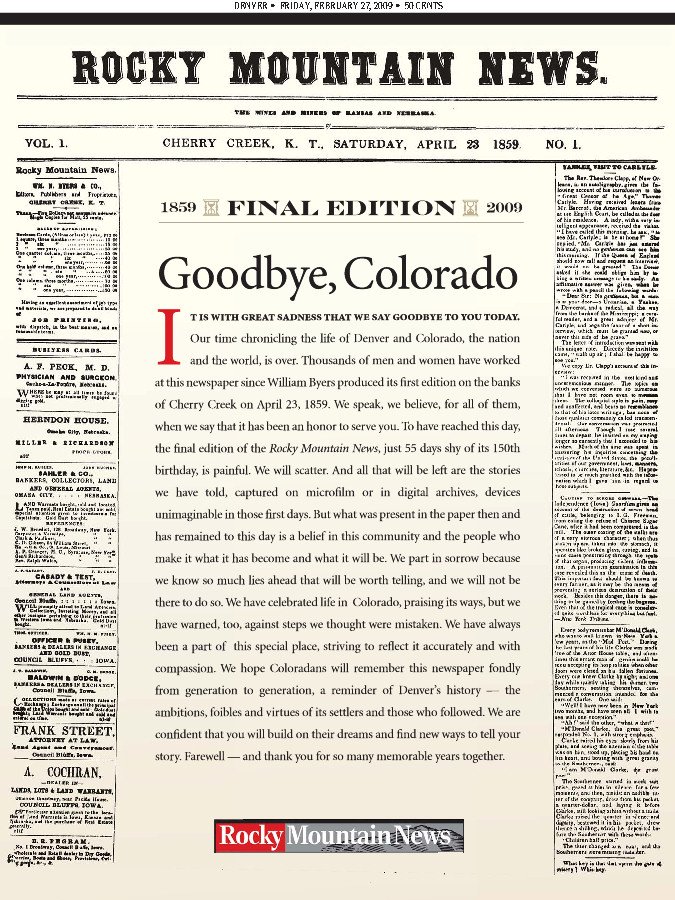
Final front page of the Rocky Mountain News (via Newseum.org)
It is with sadness that I note the passing of the Rocky Mountain News, which ceased publications a few weeks ago.
It, like many other publications, was feeling the pressure of the economic crisis currently gripping businesses around the world. The paper was bleeding millions in red ink before it was shut down, throwing hundreds of staff out of work.
Sadly, with many newspaper owners reporting distressing financial results lately, I fear more papers around the world will succumb to the recession.
Some would have you believe newspapers are irrelevant anyways, economic slowdown or not, that the industry is so behind the times it couldn’t possibly keep up with the digital age. Just type in “newspapers” and “dead” in Google and you’ll see what I mean.
But not all newspapers are in dire straits. Not all newspapers are slow to adapt to the new online media environment. (The word “newspaper” might be a bit of a misnomer anyways, seeing how so many publications have good websites including multimedia, updated through the day and night with breaking news.)
I’m not just saying all this because I work for a newspaper.
What will the talking heads and political pundits talks about if there are no traditional-media reporters digging up stories? What will the bloggers blog about if there is no source material to which posts can be linked back to? (Ironically, the posting you’re reading now falls into this category, as I have done very little original reporting in writing this.)
One of the reporters I work with had one of his feature stories on wrestler Owen Hart re-written and posted online by a specialty site devoted to WWE. Sure, the text credited our newspaper and the article linked back to our website (thank you, by the way) but the person who put up the posting — and whose name appears at the top of the article — did no original research, made no phone calls, took no photos and shot no video. Our reporter and photographer/videographer did all the work. Worse yet, Google News rates the copycat article as more relevant than the original.
Another reporter noted one of his friends claimed she was trying to “confirm” the release of a Canadian aid worker for Doctors Without Borders who was held in Darfur this week. I write “confirm” in quote marks because this person was writing an article using news stories on the Internet as her source. This person did not call the Canadian embassy nearest to Darfur to check on the status of the aid worker, nor did she call the worker’s family or Doctors Without Borders to see how she was doing.
Without the work of traditional-media journalists, the news aggregators of the Internet would have a lot of down time on their hands.
That, and Google News would be mostly blank.
Sure, there are news bloggers and aggregators out there who do original work. Many of them blog as a side task to a paid journalism job. But I bet the vast majority of bloggers do little or no original research or interviews, simply using the Internet as a spark to share their ideas on the back of someone else’s work.
It’s an important function of the web — but you can’t call it reporting. You can’t call it news.
Let’s hope the bloggers and aggregators out there recognize all the help they get from those of us in traditional media — newspapers, radio and TV — who spend our lives doing the legwork that makes active and constructive Internet discussion possible.

 Ricky Leong